Female Infertility

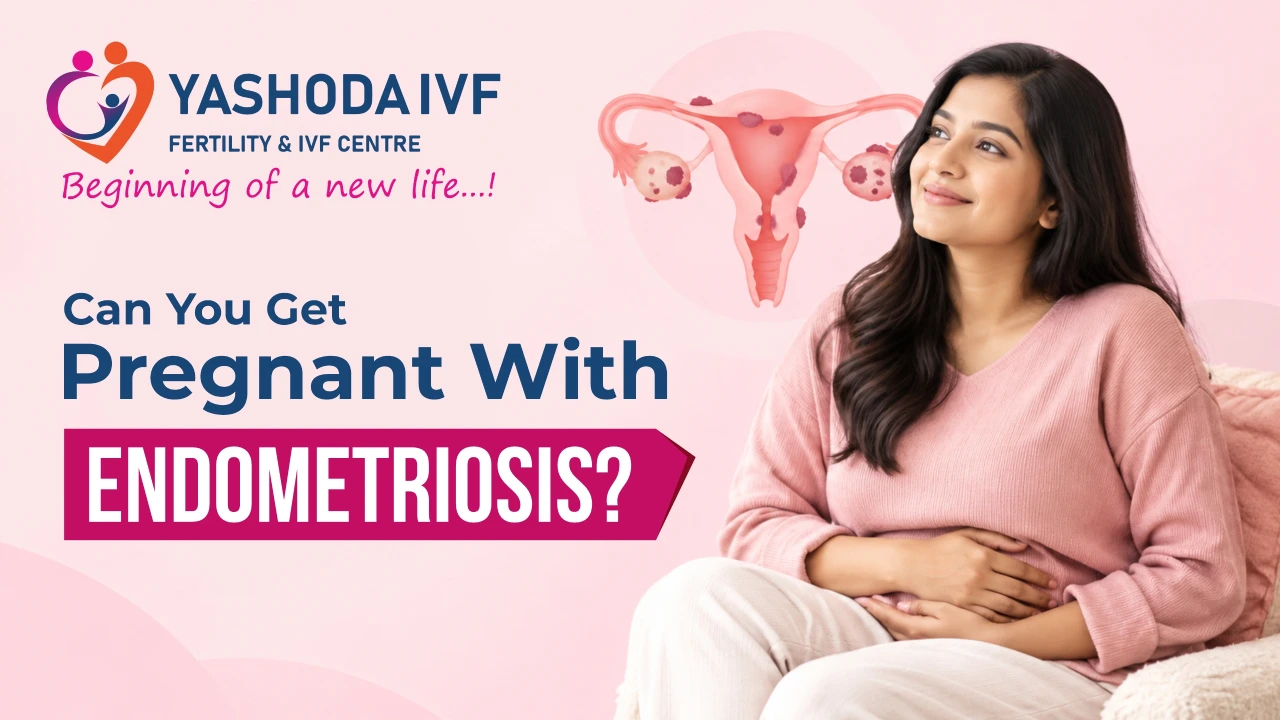
If you've been diagnosed with endometriosis and are trying to conceive, one question probably matters more than any other: can you still get pregnant? The short answer is yes: many women with endometriosis do conceive, some naturally and others with medical support. But the condition can make the journey more complicated, and understanding why is the first step toward finding the right treatment path.
This article explains how endometriosis affects fertility, what your real chances of pregnancy look like, and the treatment options available today, including how a specialised fertility centre like Yashoda IVF approaches endometriosis-related infertility.
Endometriosis is a condition in which tissue similar to the lining of the uterus (the endometrium) grows outside the uterus, commonly on the ovaries, fallopian tubes, or the pelvic lining. Like the normal uterine lining, this tissue responds to hormonal changes during the menstrual cycle, thickening and breaking down each month. But unlike the tissue inside the uterus, it has no way to leave the body, which leads to inflammation, scar tissue, and often significant pain.
Endometriosis is one of the most common gynaecological conditions in women of reproductive age, and it frequently goes undiagnosed for years because its symptoms are often mistaken for "normal" period pain.
Read here: Endometrial Thickness: Normal Range, Symptoms & Treatment
Not every woman with endometriosis has obvious symptoms, but common signs include:
Because symptoms vary so widely and some women have no symptoms at all, endometriosis is sometimes only discovered during a fertility evaluation.
Endometriosis can interfere with fertility in several ways:
Importantly, having endometriosis does not automatically mean infertility. It means the odds are shifted, and how much they're shifted depends largely on how severe the condition is.
Read here: Endometriosis vs Adenomyosis: Symptoms & Differences
Yes. Endometriosis makes pregnancy more difficult for many women, but it does not make it impossible. Research consistently shows that a large proportion of women with mild to moderate endometriosis conceive without any fertility treatment at all, often within a year or two of trying. Even women with more advanced endometriosis go on to have healthy pregnancies, frequently with the help of fertility treatment.
The key takeaway: an endometriosis diagnosis is a signal to plan and act early, not a reason to lose hope.
Fertility outcomes depend heavily on the stage of endometriosis, generally classified from Stage 1 (minimal) to Stage 4 (severe):
Age, ovarian reserve, and whether both fallopian tubes are affected also play a significant role. This is why a personalised fertility assessment matters more than general statistics; every woman's situation is different.
Read this: फैलोपियन ट्यूब ब्लॉक होने के लक्षण क्या हैं? संकेत और इलाज
If endometriosis is suspected, a fertility specialist may recommend:
Diagnosis isn't always straightforward, since ultrasounds and blood tests can appear normal even when endometriosis is present. This is one reason unexplained infertility sometimes turns out to be undiagnosed endometriosis.
Treatment depends on the severity of endometriosis, your age, and your fertility goals. Common approaches include:
At Yashoda IVF, endometriosis-related infertility is evaluated on a case-by-case basis, combining diagnostic imaging, laparoscopic expertise where needed, and individualised IVF protocols designed around each woman's ovarian reserve and disease severity rather than a one-size-fits-all approach.
Read here: Hysteroscopy vs Laparoscopy: Procedure & Differences
Not necessarily for every woman, and this is an important, honest point: surgery can improve natural conception chances for many women with endometriosis, particularly when adhesions or blocked tubes are corrected. However, in cases of significantly reduced ovarian reserve, repeated surgery can sometimes reduce egg reserve further, which is why fertility specialists carefully weigh the decision to operate against the option of moving directly to IVF, especially for women who are already trying to conceive.
Consider consulting a fertility specialist if:
Early evaluation matters because endometriosis can progress over time, and starting fertility treatment sooner generally preserves more options.
Every woman's experience with endometriosis is different, which is why Yashoda IVF focuses on individualised care rather than standard protocols. The approach typically includes a thorough diagnostic work-up to understand the stage and impact of endometriosis, followed by a tailored plan, whether that means monitored natural conception, IUI, laparoscopic treatment, or IVF.
For many women with moderate to severe endometriosis, IVF at a centre experienced in managing endometriosis-related infertility offers a realistic and effective path to pregnancy, since it addresses several of the biological barriers endometriosis creates at once.
Yes, endometriosis is one of the most common causes of infertility in women, though it affects each woman differently depending on severity and location.
Many women with mild to moderate endometriosis do conceive naturally, sometimes with a longer time-to-pregnancy than average. Severe endometriosis makes natural conception harder but not impossible.
Pregnancy often temporarily eases endometriosis symptoms due to hormonal changes, though it isn't a permanent treatment for the condition.
IVF can be an effective option for endometriosis-related infertility, particularly for moderate to severe cases, since it bypasses many of the fertility barriers the condition creates.
This depends on your specific situation, the type and location of endometriosis, your age, and ovarian reserve. A fertility specialist can help determine whether surgery, IUI, or IVF is the better first step for you.
An endometriosis diagnosis can feel overwhelming, especially when you're also trying to start or grow a family. But it's important to remember that endometriosis and infertility are not the same thing; many women with this condition do go on to have successful pregnancies, whether naturally or with fertility treatment.
If you have endometriosis and are concerned about your fertility, don't wait to seek expert guidance. The specialists at Yashoda IVF can evaluate your specific situation and recommend a treatment path suited to your needs and goals.
Book a Consultation at Yashoda IVF →
Medical Disclaimer: This article is intended for general informational purposes only and does not replace diagnosis or advice from a qualified medical professional. Please consult your doctor for guidance based on your individual health and fertility needs.