Female Infertility

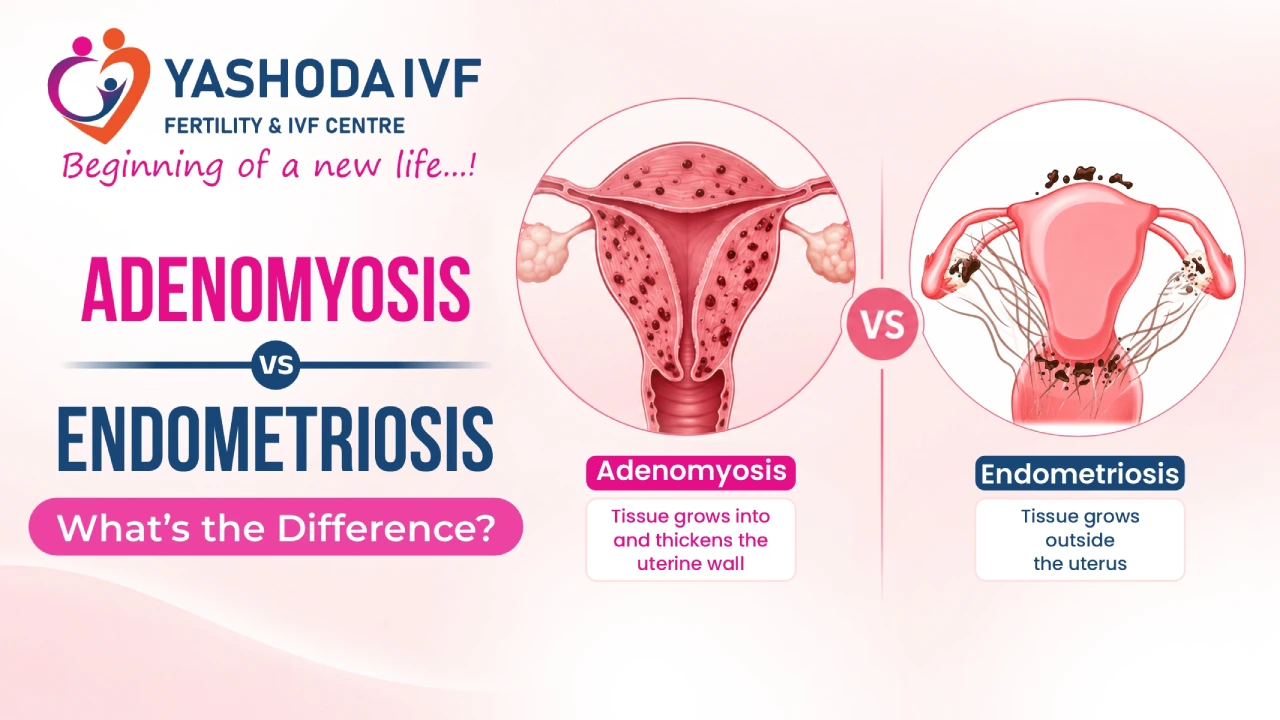
The main difference between endometriosis and adenomyosis is where the tissue is located. In endometriosis, tissue resembling the uterine lining develops outside the uterus. In adenomyosis, similar tissue is found within the muscular wall of the uterus. Both may cause painful periods, heavy bleeding, pelvic pain, and fertility difficulties, but their diagnosis and treatment can differ.
This guide breaks down endometriosis and adenomyosis in simple terms, so you know what to ask your doctor about next.
This content is intended for general education and should not be used in place of professional medical advice, diagnosis, or treatment. Please consult a qualified gynaecologist or fertility specialist for guidance specific to your health.
Endometriosis is a condition in which tissue similar to the uterine lining grows outside the uterus, in places like the ovaries, fallopian tubes, or pelvic lining.
Endometriosis tissue may respond to hormonal changes during the menstrual cycle. It can contribute to inflammation, scar tissue, adhesions, and ovarian cysts called endometriomas. However, the exact causes and mechanisms of endometriosis are not fully understood.
Common symptoms:
Some people with endometriosis have no noticeable symptoms and only discover it during a fertility evaluation.
Adenomyosis occurs when tissue resembling the uterine lining is found within the muscular wall of the uterus. This may cause the uterine wall to thicken and can sometimes lead to an enlarged, tender uterus, heavy menstrual bleeding, and painful periods.
Adenomyosis may cause a bulky or enlarged uterus, but a "bulky uterus" on an ultrasound report does not automatically mean adenomyosis. Fibroids and other conditions can also affect uterine size.
Common symptoms:
Adenomyosis is often diagnosed in women in their 30s and 40s, though it can occur earlier too.
| Feature | Endometriosis | Adenomyosis |
|---|---|---|
| Tissue location | Outside the uterus | Within the muscular uterine wall |
| Common symptoms | Pelvic pain, painful periods, pain during intercourse | Heavy bleeding, painful periods, pelvic pressure |
| Age pattern | Often diagnosed during the reproductive years | Often diagnosed in the 30s and 40s, but can occur earlier |
| Uterus size | Often normal, although other findings may be present | May be enlarged or globular |
| Common imaging | Ultrasound; MRI in selected cases | Transvaginal ultrasound; MRI when required |
| Role of laparoscopy | May diagnose or treat selected cases | Not generally used to diagnose adenomyosis |
| Fertility impact | May affect fertility through several mechanisms | Associated with implantation and fertility difficulties |
| Can both coexist? | Yes | Yes |
Yes. Endometriosis and adenomyosis can occur together, although reported coexistence rates vary by population and diagnostic method. If your doctor suspects one, they may evaluate for the other as well.
The symptoms overlap considerably. Pain, heavy periods, and fertility issues can appear in both conditions, and both involve similar tissue behaviour in different locations.
Symptoms alone cannot reliably distinguish the two, which is why imaging or specialist evaluation is important.
Symptoms alone cannot reliably distinguish the two conditions. A doctor will consider menstrual history, pain patterns, fertility history, examination findings, and imaging results.
A normal ultrasound or MRI does not completely rule out endometriosis, particularly superficial disease.
Imaging can strongly suggest adenomyosis. Examination of uterine tissue after hysterectomy can provide confirmation, but hysterectomy is not performed simply to establish the diagnosis.
Ultrasound can identify ovarian endometriomas and, in experienced hands, some signs of deep endometriosis. It can also pick up features suggestive of adenomyosis, such as changes in the muscular wall of the uterus.
However, a normal ultrasound cannot completely rule out endometriosis, particularly milder or superficial disease. When ultrasound findings are unclear, a doctor may recommend an MRI for further evaluation.
When fertility is a concern, a doctor may also recommend an HSG test to evaluate the uterine cavity and check whether the fallopian tubes appear open. An HSG cannot diagnose or rule out endometriosis or adenomyosis.
Both conditions may affect fertility, but their impact varies considerably between individuals.
Endometriosis may affect fertility through inflammation, adhesions, altered pelvic anatomy, fallopian-tube involvement, or ovarian endometriomas. Endometriomas and sometimes surgery performed to treat them may affect ovarian reserve. An AMH test can contribute to ovarian-reserve assessment, but it cannot measure egg quality or predict natural pregnancy on its own.
Adenomyosis has been associated with implantation and fertility difficulties and may affect the uterine environment or uterine contractions. However, the degree of impact differs between patients, and research is continuing.
Neither condition makes pregnancy impossible. Depending on age, ovarian reserve, semen parameters, fallopian-tube health, disease severity, and how long pregnancy has been attempted, a fertility specialist may recommend natural conception, IUI, or IVF.
Treatment depends on the severity of symptoms, age, pregnancy plans, imaging findings, and how the condition affects daily life.
Hormonal medicines used to control symptoms generally prevent pregnancy while they are being taken. Treatment must therefore be planned differently when conception is the immediate goal.
When pregnancy is the immediate goal, symptom-control hormones that prevent conception are generally not used, or are used differently. Instead, treatment decisions depend on factors such as age, ovarian reserve, fallopian-tube health, semen analysis, the severity of symptoms, and how long conception has been attempted.
A fertility specialist may recommend a period of natural attempts, ovulation monitoring, IUI, or IVF depending on this overall picture. IUI (Intrauterine Insemination) and IVF (In Vitro Fertilization) are fertility treatments; they do not remove or cure endometriosis or adenomyosis, but they can help achieve pregnancy alongside appropriate management of the underlying condition.
Consider seeing a specialist if you notice:
Early evaluation helps identify the right diagnosis sooner.
Not necessarily. Adenomyosis often causes heavier bleeding and cramping, while endometriosis can cause wider pelvic pain and, in some cases, involve organs beyond the uterus. Severity varies from person to person for both conditions.
No. They are separate conditions, though they can occur together.
Adenomyosis symptoms often improve after menopause as hormone levels change. However, persistent or new pelvic pain or bleeding after menopause requires medical evaluation.
Many people with endometriosis or adenomyosis do conceive, either naturally or with fertility treatment, depending on severity and individual factors. A fertility specialist can assess your specific situation.
No. Many cases are managed with medication first. Surgery is considered for severe symptoms or when fertility is affected.
Endometriosis involves tissue outside the uterus. Adenomyosis involves tissue within the uterine wall. Both may cause pain and may affect fertility, though not every patient experiences these problems, and both are manageable with appropriate diagnosis and care.
If your symptoms sound familiar, avoid self-diagnosing. The team at Yashoda IVF can evaluate fertility-related concerns and coordinate appropriate specialist assessment to help clarify the right next steps for your care.
Disclaimer: The information provided in this blog is for educational and informational purposes only and is not intended as a substitute for professional medical advice, diagnosis, or treatment. Every individual's health situation is unique; please consult a qualified doctor before making treatment decisions.