Fertility Tips
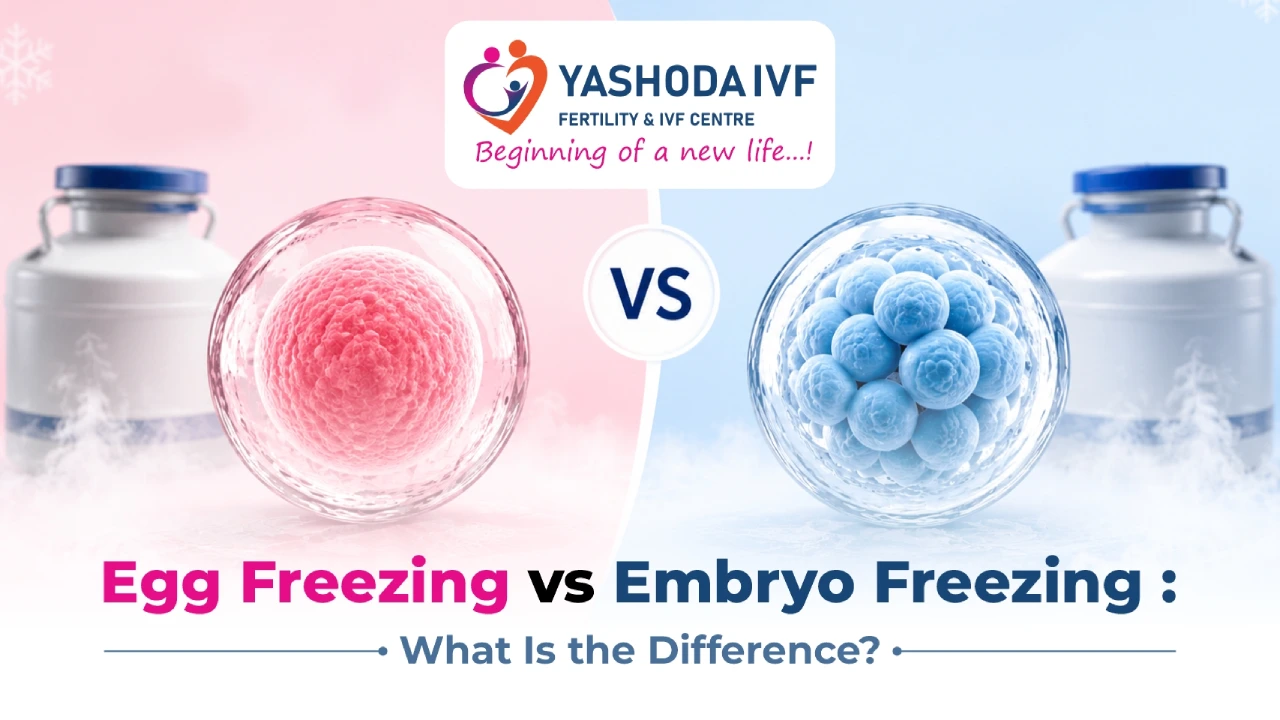
Egg freezing stores mature, unfertilised eggs for possible use later. Embryo freezing stores embryos that have already been created by fertilising eggs with sperm. Both are fertility preservation methods, but they differ in fertilisation status, sperm requirement, future steps, and the kind of decisions you need to make before and after freezing. Understanding egg freezing vs embryo freezing can help you have a more informed conversation with your doctor.
| Factor | Egg Freezing | Embryo Freezing |
|---|---|---|
| What is frozen | Unfertilised mature eggs | Embryos created after eggs are fertilised with sperm |
| Fertilisation status | Not fertilised at freezing | Already fertilised |
| Sperm required | Not at the time of freezing | Yes, before freezing |
| Main laboratory stage | Egg retrieval and vitrification | Fertilisation and embryo culture before vitrification |
| Future steps | Thawing, fertilisation, embryo development, and then transfer | Preparation of the uterine lining, embryo thawing, and embryo transfer |
| Reproductive flexibility | Partner/sperm source can be decided later | The partner and sperm source are already fixed |
| Information available before storage | Number and maturity of retrieved eggs, with limited information about their future fertilisation and developmental potential | Fertilisation outcome and early embryo development can be reviewed |
| Consent considerations | Usually involves one individual | May involve both partners who contributed sperm and eggs |
| Suitable circumstances | Varies by personal and medical situation | Varies by personal and medical situation |
| Pregnancy guarantee | Not guaranteed | Not guaranteed |
The most important difference is timing: with egg freezing, fertilisation happens in the future; with embryo freezing, fertilisation has already happened before storage. This single difference affects sperm requirements, the information your doctor can review before freezing, and the decisions you may face later.
Egg freezing, medically known as oocyte cryopreservation, is a process where a woman's mature eggs are retrieved and frozen without fertilising them first. The eggs are stored so that, if needed in the future, they can be thawed, fertilised, and used to attempt a pregnancy.
Embryo freezing involves retrieving eggs and fertilising them with sperm through IVF treatment or ICSI treatment (a technique where a single sperm is injected directly into an egg) before the resulting embryos are frozen. Unlike egg freezing, fertilisation takes place before the freezing step, not after.
The core difference is fertilisation timing: egg freezing preserves eggs before fertilisation, while embryo freezing preserves eggs after they have already been fertilised with sperm. This affects whether sperm is needed immediately, how much information is available before storage, and what steps remain before a pregnancy attempt.
In egg freezing, the eggs remain unfertilised in storage. In embryo freezing, fertilisation has already taken place, and the stored material consists of developing embryos rather than individual eggs.
Egg freezing does not require sperm at the time of freezing, since fertilisation is deferred to a later date. Embryo freezing requires sperm before storage, because fertilisation must occur first.
Because eggs are unfertilised, egg freezing allows the decision about a sperm source or partner to be made later. With embryo freezing, this decision is already fixed at the time the embryos are created.
With egg freezing, only the number and general appearance of retrieved eggs are known before storage. With embryo freezing, doctors can also observe fertilisation success and early embryo development, offering more information before the freezing step.
Frozen eggs must go through thawing, fertilisation, and embryo development before a transfer can be considered. Frozen embryos have already passed through fertilisation and early development, so the main step remaining is thawing followed by embryo transfer.
Egg freezing generally centres on the consent of the person whose eggs are stored. Embryo freezing may require documented consent and future-use decisions from the people whose reproductive material was used, subject to applicable Indian regulations and clinic policies.
Despite their differences, both methods share several steps and considerations:
Most importantly, neither egg freezing nor embryo freezing can guarantee a future pregnancy or live birth.
Read this blog: What Is Ovulation? Signs, Symptoms & Fertility Guide
Read this blog: Positive Signs After Embryo Transfer: Early Pregnancy Clues
There is no simple, one-line answer to this question, because "success" is measured at several different stages, and each stage depends on different factors.
These stages are distinct, and progress at one stage does not guarantee success at the next. Outcomes at each stage may depend on:
Because embryo freezing allows some early development to be observed before storage, some couples find it offers more information upfront. However, this does not automatically translate into a higher chance of a live birth for every individual, since so many personal and medical variables are involved. A fertility specialist can help interpret how these factors may apply to your specific situation.
Egg freezing may be a relevant option for:
This list is illustrative, not a recommendation, and suitability should be assessed individually.
Embryo freezing may be a relevant option for:
In general, eggs frozen at a younger reproductive age have better potential than eggs frozen later because egg quality declines with age. Freezing before age 35 is often discussed, but there is no universally correct age, and individual ovarian reserve, medical history, and family-building plans must also be considered.
It's also useful to understand the difference between ovarian reserve and egg quality. Ovarian reserve refers to the approximate number of eggs remaining, often estimated using tools like an ovarian reserve test or an AMH test (anti-Müllerian hormone test). However, the AMH test should not be treated as a direct measure of egg quality, nor does it guarantee future pregnancy on its own. It primarily reflects egg quantity, not how those eggs will perform during fertilisation or embryo development.
Because so many individual factors are involved, fertility assessment should always be personalised. Readers should avoid treating any single age as a universal deadline and should instead discuss their specific health profile with a specialist.
Eggs and embryos are kept in cryopreservation, a process of storing biological material at very low temperatures to pause biological activity. Storage duration depends on proper laboratory procedures, consistent monitoring, and accurate clinical documentation.
Clinics maintain detailed records and require clear consent forms covering how long material will be stored and what happens under different circumstances. It is important to follow applicable Indian regulations and individual clinic policies regarding storage duration, renewal, and consent updates.
Storage duration alone should not be seen as the main predictor of future outcomes. Factors such as the age at which the eggs or embryos were originally frozen and the quality of the freezing process tend to matter more than how long they have been stored.
Yes, frozen eggs can become embryos later, but this requires several additional steps after storage. The general sequence is:
Thawing → fertilisation through IVF or ICSI → embryo development → assessment → embryo transfer
It's important to understand that not every frozen egg will necessarily survive thawing, not every surviving egg will fertilise, and not every fertilised egg will develop into a suitable embryo for transfer. Each step involves a possibility of narrowing down the number of eggs that eventually become a transferable embryo, which is why outcomes cannot be predicted with certainty in advance.
There is no universally better option between egg freezing and embryo freezing. The right choice depends on your individual circumstances, including:
Because these factors vary so widely from person to person, this decision is best made after a detailed, personalised consultation with a qualified fertility specialist who can review your specific health profile and goals.
No. Egg freezing stores unfertilised eggs, while embryo freezing stores eggs that have already been fertilised with sperm. This difference affects sperm requirements, the information available before storage, and the steps needed before a future pregnancy attempt.
Neither is universally better. The right choice depends on factors such as age, medical history, availability of a sperm source, relationship circumstances, and personal preferences. A fertility specialist can help you decide based on your individual situation.
Yes. Embryo freezing requires sperm at the time the embryos are created, because fertilisation must take place before the resulting embryos can be frozen and stored.
Egg freezing may be considered by unmarried women who wish to preserve future reproductive options, subject to medical assessment and clinic policies. It is best discussed directly with a fertility specialist to understand personal suitability and applicable guidelines.
Yes, but only after several additional steps: thawing, fertilisation through IVF or ICSI, embryo development, and assessment. Not every frozen egg will necessarily survive this process or become a suitable embryo for transfer.
The main difference between egg freezing and embryo freezing is whether fertilisation happens before or after freezing. Egg freezing preserves unfertilised eggs, offering flexibility for the future, while embryo freezing preserves already-fertilised embryos, offering more information at the time of storage. The appropriate option depends on your medical history, age, relationship circumstances, and personal preferences, and neither method can guarantee a future pregnancy. A personalised fertility evaluation remains the most reliable way to understand which path may suit you.
Choosing between egg freezing and embryo freezing is a personal and medical decision. Visit your nearest Yashoda IVF Centre for a personalised fertility evaluation and guidance from an experienced fertility specialist.
Disclaimer: This blog is intended for general informational purposes and should not replace professional medical advice. Please consult a qualified healthcare provider for any concerns about your reproductive health.