Fertility Tips
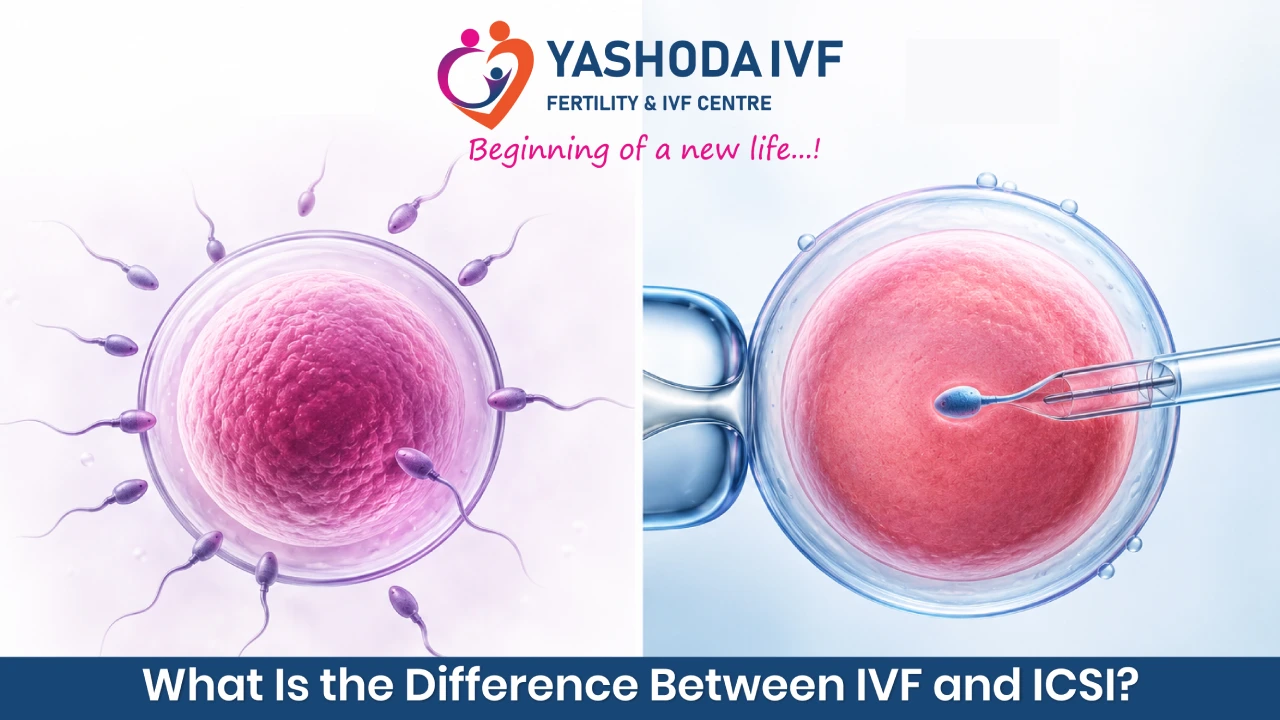
If you're exploring fertility treatments, you've probably come across two terms that sound similar but aren't quite the same: IVF and ICSI. Both help couples who are struggling to conceive, and both involve fertilising an egg in a laboratory. So what's the actual difference? In simple words, the main IVF and ICSI difference lies in how the egg is fertilised. In IVF, sperm fertilises the egg on its own; in ICSI, a single healthy sperm is injected directly into the egg by an embryologist.
Understanding the IVF vs ICSI comparison can help you feel more confident about your treatment options. Let's break it down in clear, easy language.
IVF, or In Vitro Fertilisation, is one of the most well-known and widely used fertility treatments in the world. "In vitro" means "in glass," which refers to fertilisation happening outside the body, in a lab dish.
During IVF, a woman's ovaries are stimulated with medication to produce multiple eggs. These eggs are then collected and placed in a special dish together with thousands of sperm. The sperm are left to fertilise the eggs naturally on their own, meaning the strongest sperm swims to and penetrates the egg without help. Once fertilisation happens, the resulting embryo is grown for a few days and then transferred into the uterus.
IVF is often the first choice for couples dealing with blocked fallopian tubes, ovulation problems, endometriosis, or unexplained infertility.
ICSI, or Intracytoplasmic Sperm Injection, is a more advanced and precise form of fertilisation that is actually performed within an IVF cycle. In fact, ICSI isn't a completely separate treatment; it's a specialised fertilisation technique used during IVF.
The early steps of ICSI are the same as IVF: the ovaries are stimulated, and eggs are collected. The key difference comes at the fertilisation stage. Instead of leaving sperm and egg together to fertilise on their own, an embryologist selects one healthy, good-quality sperm and injects it directly into the centre of a single egg using a fine glass needle. This bypasses many of the natural barriers to fertilisation.
ICSI was developed mainly to help couples facing male infertility, such as low sperm count, poor sperm movement, or abnormal sperm shape.
Here's the simplest way to remember the IVF and ICSI difference:
Everything else about the two procedures, the ovarian stimulation, egg collection, embryo culture, and embryo transfer, is essentially the same. The one crucial step where they differ is fertilisation, and that single difference changes which patients each method is best suited for.
Both treatments follow the same overall journey, with the fertilisation step being the point of difference:
A common question is which treatment has better success rates. The honest answer is that it depends on the underlying cause of infertility.
For couples without male-factor infertility, IVF and ICSI have very similar success rates, because once fertilisation happens, the embryo implantation process is the same. Reported IVF success rates generally range from around 40% to 60%, depending heavily on the woman's age and egg quality.
For couples with male infertility, ICSI often performs better because it overcomes sperm-related barriers. ICSI achieves high fertilisation rates, frequently in the 80–90% range, which is why it's the preferred choice when sperm quality is a concern.
However, it's important to understand that a higher fertilisation rate doesn't automatically mean a higher pregnancy rate. ICSI improves the chance of fertilisation, but it cannot fix issues like egg quality, embryo development, or uterine problems. This is why ICSI isn't automatically "better" than IVF for everyone; it's simply better suited to specific situations.
When comparing IVF vs ICSI cost, ICSI is usually slightly more expensive than standard IVF. This is because ICSI involves an extra, highly skilled step of injecting sperm into each egg individually, which requires specialised equipment and an experienced embryologist.
That said, the difference in cost is often modest, and for couples with male-factor infertility, the added investment can significantly improve the chances of fertilisation. Your fertility specialist can guide you on which option offers the best value for your specific situation. You can explore the full range of options on our treatments page.
IVF is typically the recommended choice when:
In these cases, natural fertilisation in the lab usually works well, and standard IVF is both effective and cost-friendly.
ICSI is usually recommended when male-factor infertility is involved, including:
ICSI is also often used alongside genetic testing of embryos, since it allows precise control over fertilisation.
| Feature | IVF | ICSI |
|---|---|---|
| Fertilisation method | Sperm fertilises the egg naturally in a dish | A single sperm injected directly into an egg |
| Best for | Female-factor or unexplained infertility | Male-factor infertility |
| Sperm requirement | Healthy sperm in good numbers | Works even with very low/poor sperm |
| Fertilisation control | Natural selection | Precisely controlled by an embryologist |
| Cost | Slightly lower | Slightly higher |
| Fertilisation rate | Good with healthy sperm | High (often 80–90%) |
There's no one-size-fits-all answer, because "better" depends entirely on why a couple is struggling to conceive. Neither procedure is universally superior.
For couples with healthy sperm and female-related fertility challenges, standard IVF is often the smarter, more cost-effective choice. For couples where sperm quality is the main issue, or where fertilisation has failed before, ICSI offers a real advantage by making fertilisation possible when it otherwise might not happen.
The right decision should always be based on a proper diagnosis and your fertility specialist's expert advice, not on the assumption that the more advanced or expensive option is automatically better.
The core IVF and ICSI difference is simple: IVF lets sperm fertilise the egg naturally in the lab, while ICSI injects a single sperm directly into the egg. Both are highly effective assisted reproductive treatments that share the same overall journey, differing only at the fertilisation step. IVF is ideal for female-factor and unexplained infertility, while ICSI is the go-to solution for male-factor infertility. At Yashoda IVF Fertility Centre, experienced fertility specialists carefully evaluate each couple's condition to recommend the most suitable treatment, helping improve the chances of a successful pregnancy.
If you're trying to decide between the two, the best step is to consult an experienced fertility team that can assess your unique situation and recommend the right path. With the correct diagnosis and expert care, both IVF and ICSI can turn the dream of parenthood into reality.
No. ICSI is better specifically for male-factor infertility, but for other causes, it doesn't necessarily improve pregnancy chances compared to standard IVF.
Yes. ICSI is a specialised fertilisation technique performed within an IVF cycle; the only difference is how the egg is fertilised.
Usually, yes. ICSI involves an extra skilled step, so it's slightly more expensive, though the difference is often modest.
For male-factor infertility, ICSI often achieves higher fertilisation rates. For other cases, both have similar success rates once fertilisation occurs.
Your fertility specialist will make a decision based on tests, particularly sperm quality. Male-factor issues usually point to ICSI, while other causes often suit IVF.
Disclaimer: The information provided in this blog is for educational and informational purposes only and is not intended as a substitute for professional medical advice, diagnosis, or treatment. Every individual's fertility journey is unique.