
IVF
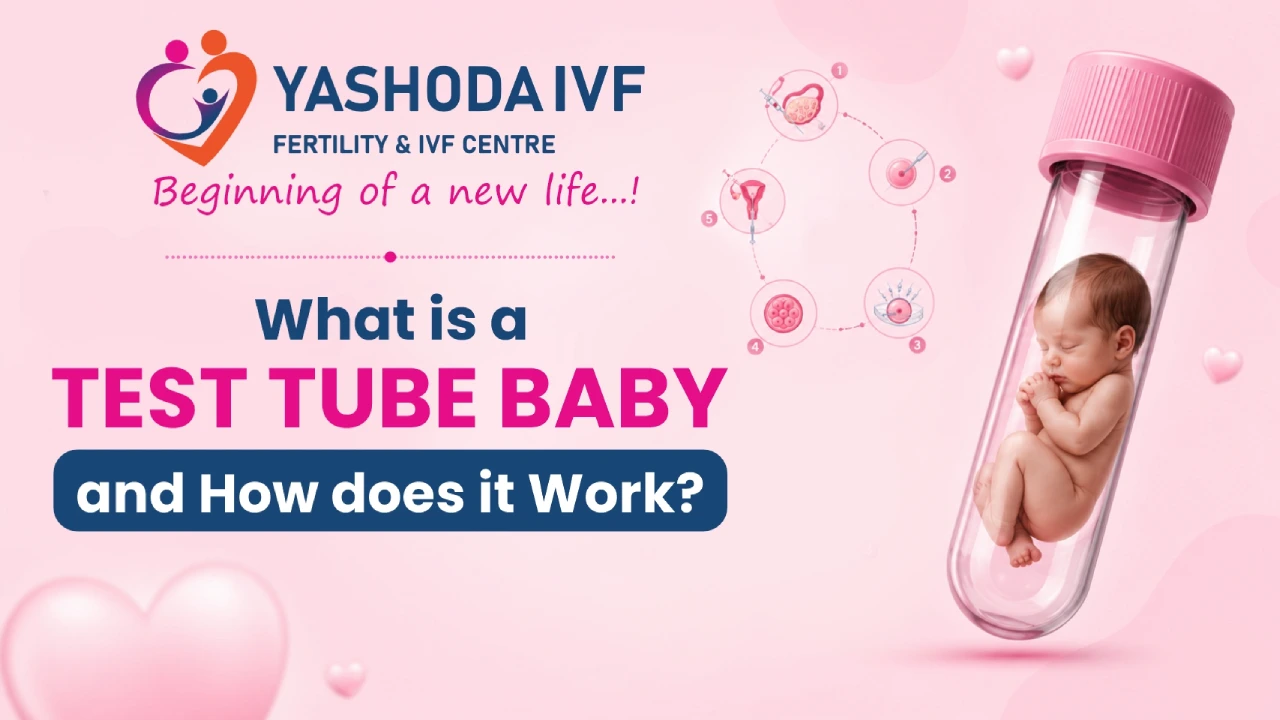
A test tube baby is the common, everyday term for a baby conceived through IVF treatment (In Vitro Fertilisation), a process where an egg and sperm are combined outside the body in a laboratory rather than inside a test tube. Once fertilisation takes place and the resulting embryo develops for a few days in the lab, it is transferred into the uterus. From that point, the embryo still needs to implant in the uterine lining for a pregnancy to begin, a step called implantation, which does not happen in every transfer. This article explains what the term actually means, how the process works step by step, and who may consider it with guidance from the fertility team at Yashoda IVF.
The phrase "test tube baby" became popular in the late 1970s, when the world's first successful case of external fertilisation made global headlines. Over time, it stuck as an informal way to describe any child conceived through IVF, even though the actual process has never involved an actual test tube.
Medically, the correct term is In Vitro Fertilisation, where "in vitro" simply means "in glass" referring to laboratory conditions rather than any specific tube-shaped container. The term "test tube baby" is still widely used in everyday conversation across India, which is why it remains a common search term, even though IVF treatment is the accurate medical description.
No. Despite the name, fertilisation does not happen inside a test tube. In a modern IVF laboratory, eggs and sperm are combined in a small, flat laboratory dish under carefully controlled temperature and conditions. This dish allows embryologists to monitor fertilisation and early development closely, something that would not be possible inside a narrow tube. The "test tube" name has simply carried over from decades ago and continues to be used as a familiar, easy-to-understand term.
The test tube baby process, or IVF, generally follows these stages:
Before starting treatment, both partners typically undergo an initial fertility check-up, including blood tests, ultrasound scans, and in some cases, a semen analysis, to understand overall reproductive health and plan the treatment appropriately.
Hormonal injections are given over roughly 10-14 days to encourage the ovaries to develop multiple eggs in a single cycle, rather than the one egg typically released during a natural cycle.
Regular ultrasound scans and blood tests track follicle growth and hormone levels, helping the medical team decide the right time for the next step.
Once follicles reach an appropriate size, a trigger injection is given to help the eggs complete their final maturation. Egg retrieval is timed carefully around this injection, since it determines when the eggs will be ready to collect.
A minor procedure, usually performed under sedation, is used to collect mature eggs directly from the ovaries.
On the same day, a semen sample is processed in the laboratory through a technique called sperm washing, which separates healthy, motile sperm from seminal fluid and other cells before fertilisation.
The prepared sperm and retrieved eggs are combined in a laboratory dish. Depending on the situation, this may be done through conventional IVF or through ICSI treatment, a technique where a single sperm is injected directly into an egg to assist fertilisation.
Fertilised eggs are cultured in the laboratory for several days while embryologists monitor their growth and development.
One or more suitable embryos are transferred into the uterus through a thin catheter. This step is generally done without sedation or anaesthesia, as it's usually a quick procedure similar to a routine internal examination, though mild discomfort is possible. Any additional healthy embryos may be frozen for possible future use.
After the transfer, hormonal support medicines, commonly progesterone, are prescribed to help prepare and maintain the uterine lining, supporting implantation if it occurs.
Around 10-14 days after the embryo transfer, a Beta hCG blood test is done to check for pregnancy. Testing too early can give an inaccurate result, which is why doctors usually recommend waiting for the advised timeline rather than testing sooner.
India's first test tube baby, Kanupriya Agarwal, was born on 3 October 1978 in Kolkata. Since her birth coincided with the first day of Durga Puja that year, she came to be affectionately known as "Durga." This breakthrough was achieved by Dr. Subhash Mukhopadhyay, who worked with limited resources at the time and is now recognised as a pioneer in India's reproductive medicine history, though wider recognition of his work came only years later. Her birth made India one of the earliest countries in the world to achieve a successful IVF pregnancy, just months after the world's first test tube baby was born in the UK in 1978. Today, this milestone is remembered as the starting point of what has grown into a well-established and widely accessible fertility treatment across the country.
The main difference lies in how fertilisation takes place, outside the body in a laboratory setting for IVF, versus inside the body for natural conception. Once implantation occurs and pregnancy is confirmed, the pregnancy itself is generally managed with the same routine prenatal care and monitoring as any other pregnancy, regardless of how conception happened.
That said, it would be inaccurate to say there is no difference at all. IVF pregnancies are, on average, associated with a somewhat higher chance of certain outcomes such as multiple pregnancy (particularly if more than one embryo is transferred), and some studies have observed slightly higher rates of preterm birth or low birth weight compared with naturally conceived pregnancies. Researchers are still studying how much of this is linked to the IVF procedure itself versus underlying fertility-related or health factors in people who need IVF in the first place. These are population-level patterns, not individual predictions, and a fertility specialist can help you understand what applies to your specific situation.
IVF, or the test tube baby process, may be considered in situations such as:
This list is illustrative and not a recommendation, suitability always depends on an individual medical evaluation.
Outcomes from IVF depend on multiple factors working together, rather than any single one. These include:
No treatment can guarantee a pregnancy or live birth, and outcomes vary from person to person. A fertility specialist can help assess how these factors may apply to your specific situation.
Like any medical procedure, IVF carries some risks, and it's important to be aware of these before starting treatment:
These risks vary from person to person, and your fertility specialist will discuss which ones are most relevant to your individual treatment plan.
Based on decades of experience and research since the first IVF births, most children conceived through IVF grow up healthy, and long-term studies have generally found reassuring outcomes overall. Kanupriya Agarwal herself, India's first test tube baby, later went on to have a child of her own through natural conception, which is often cited as one example of long-term well-being after IVF conception. That said, as noted above, IVF pregnancies are associated with a modestly higher likelihood of certain complications, particularly with multiple pregnancies, so individual outcomes still depend on multiple health and genetic factors. Specific concerns are always best discussed directly with your treating doctor.
A single IVF cycle, from the start of ovarian stimulation to embryo transfer, typically takes around three to four weeks. However, the overall timeline can vary depending on individual response to treatment, whether additional testing is needed, and whether a fresh or frozen embryo transfer is planned.
| Factor | Natural Conception | IUI | Test Tube Baby (IVF) |
|---|---|---|---|
| Where fertilisation happens | Inside the body | Inside the body | In a laboratory dish |
| Sperm placement | Natural | Placed directly in the uterus | Combined with eggs in the lab |
| Egg stimulation | Not used | Sometimes used | Almost always used |
| Laboratory involvement | None | Minimal | Extensive |
| Suitable for | Couples with no fertility issues | Mild fertility factors | Wider range of fertility challenges |
| Pregnancy guarantee | Not guaranteed | Not guaranteed | Not guaranteed |
At Yashoda IVF, every test tube baby journey begins with a detailed fertility check-up to understand your individual health profile. Our fertility specialists guide you through each stage of the process from ovarian stimulation and monitoring to egg retrieval, laboratory fertilisation, and embryo transfer with regular updates at every step. Since every patient's situation is different, treatment plans are built around individual assessment rather than a one-size-fits-all approach.
A test tube baby is the common term for a baby conceived through IVF, where an egg and sperm are combined in a laboratory dish rather than inside the body, and the resulting embryo is later transferred to the uterus.
It refers to a baby born through In Vitro Fertilisation. The name comes from the idea of fertilisation happening in a lab, though it actually takes place in a flat dish, not an actual test tube.
No. Fertilisation and early embryo development happen in a laboratory dish under controlled conditions. The embryo is then transferred to the uterus, where the rest of the pregnancy proceeds as usual.
Kanupriya Agarwal, also known as "Durga," was born on 3 October 1978 in Kolkata, making her India's first test tube baby.
It generally involves fertility assessment, ovarian stimulation, monitoring, egg retrieval, fertilisation in the lab, embryo development, and embryo transfer.
This article draws on general medical understanding of IVF as described by recognised health authorities, including:
For guidance specific to your health, please consult a qualified fertility specialist rather than relying solely on this or any other general article.
A test tube baby is simply the everyday term for a baby conceived through IVF, where fertilisation takes place in a laboratory dish rather than inside the body. From India's first test tube baby in 1978 to the advanced fertility treatments available today, this process has helped countless families move forward on their path to parenthood; though, like any fertility treatment, it cannot guarantee a pregnancy for every individual.
If you're exploring test tube baby treatment or want to understand which fertility option may suit your situation, visit your nearest Yashoda IVF Centre for a personalised evaluation and guidance from an experienced fertility specialist.
Disclaimer: The information provided in this blog is for educational and informational purposes only and is not intended as a substitute for professional medical advice, diagnosis, or treatment. Every individual's fertility journey is unique.